

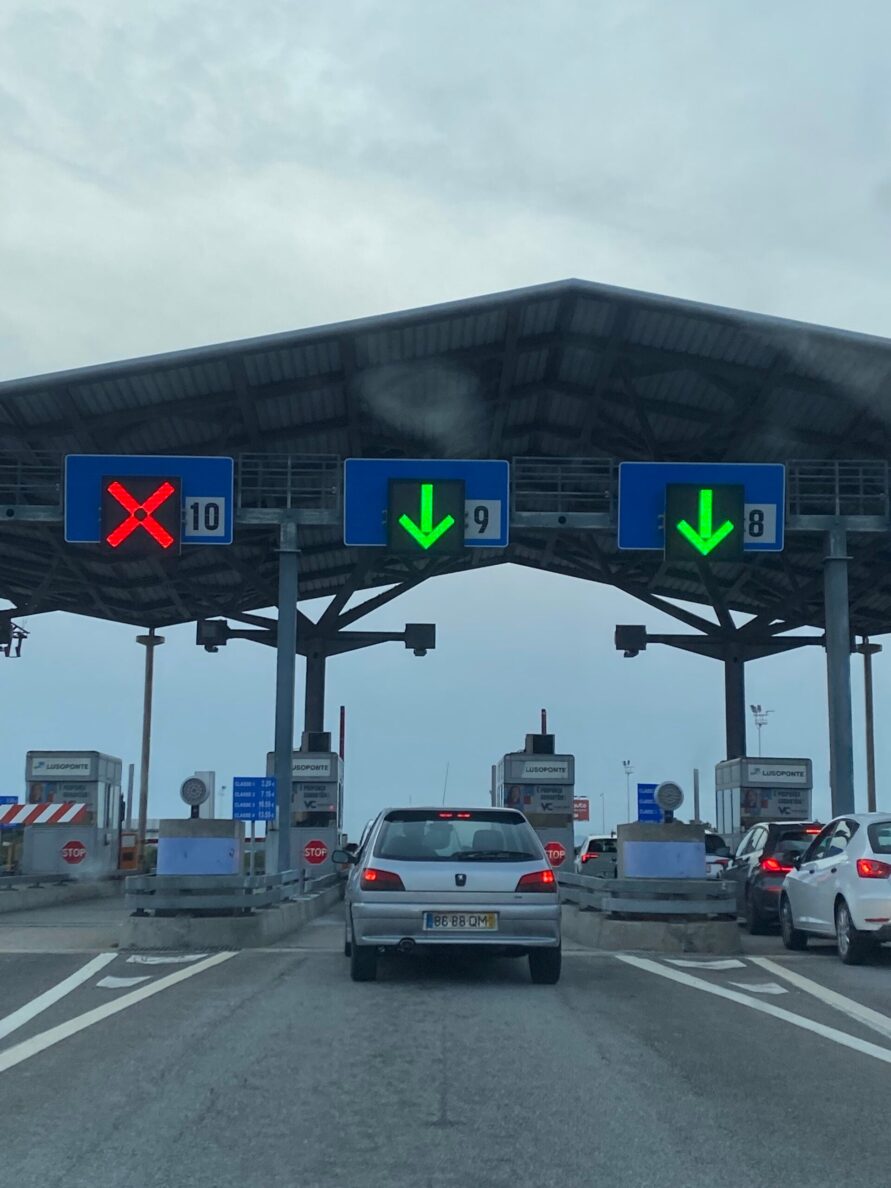
- An important question for anyone traveling in Portugal by car: the Portuguese toll road system can be confusing, especially for tourists. Here’s a clear explanation.
Portugal has three types of toll roads, and the payment method varies by type:
The Three Types of Toll Roads
• Vignette System (Portagens Electrónicas): These are electronic toll roads without barriers. You drive through barriers (usually indicated with a green arrow or “Via Verde”). This is the most common type on major highways (A-motorways, such as the A1 from Lisbon to Porto). There are no barriers or toll booths where you can stop and pay cash.
Traditional Toll Gates (Portagens Manuais): These have barriers and toll booths. You can pay with cash or a card (usually credit card). Choose the lanes with a coin or card symbol, or a green cross.
Expressways (SCUTs): These are older, toll-free highways, especially inland. However, they are becoming increasingly rare, as many have been converted to electronic toll systems.
How to pay? The options at a glance
Option 1: Prepay – Rent a Via Verde transponder
How: Rent a Via Verde transponder from your car rental company. This usually costs a few euros per day plus a one-time administration fee. This is by far the simplest solution.
How it works: The transponder is attached to your windshield. It beeps at each electronic toll booth, and the toll is automatically charged to the car rental company’s credit card. You pay the rental company (usually via a later invoice).
Pros: No hassle, you can use all lanes (including the fast Via Verde lanes), and you never miss a toll booth.
Cons: Extra costs.
“Fulli” is a similar system and also an option: https://www.anwb.nl/vakantie/reisvoorbereiding/tolbadge
Option 2: Pay later – Online or at the post office (for electronic toll collection)
This is the option if you don’t have a transponder and accidentally or intentionally drive through the green gates.
• How it works: ANPR cameras record your license plate. The vehicle owner (you or the rental company) receives the invoice.
• For rental cars:
The rental company receives the invoice and debits the costs (often including a hefty administrative fee!) from your credit card. This can happen weeks after your trip.
Even better: pay online yourself within 5 business days of passing through. Then you only pay the toll itself.
How to pay online:
1. Go to the website www.portugaltolls.com (especially for foreigners).
2. Select “Pay toll later” or “Pay toll”.
3. Enter your license plate number, country code (e.g., NL or D), and the start date of your rental.
4. The system will display all outstanding toll amounts. Pay by credit card.
Important: This only works for vehicles registered outside of Portugal. For Portuguese license plates, you must go to a physical payment point.
Option 3: On-site – Cash/Card at traditional toll gates
• How: Look for lanes with a coin or card symbol, a green cross, or the word “Pagamento.” You can stop and pay there.
• Tip: Avoid lanes with only a green arrow or the “Via Verde” logo, as you cannot pay there.
Option 4: Buy a temporary prepaid card
• How: You can buy a prepaid toll card (e.g., TollCard) at many post offices (CTT), some gas stations, or motorway service areas. You must load the card and register it in the car according to the instructions. • Advantage: You have control over your spending.
• Disadvantage: Less convenient for a short trip; you have to make a purchase and activate the card.
Practical tips and warnings
Google Maps settings: Enable the “Avoid toll roads” option in Google Maps. You’ll often arrive via the beautiful, older N-roads (such as the N2), which are much more characteristic and free. This is perfect for the Tábua region, where many attractions can be reached via secondary roads.
Remember the color code: Green arrows = electronic (no cash). Red cross = closed. Green cross or symbol = payment is required.
Check your rental car: Ask the rental company explicitly: “Does this car have a Via Verde transponder and how does the toll payment work?” This will prevent most surprises.
Fines: If you pass through an electronic toll gate without paying and don’t pay (online) within the specified timeframe, you will receive a hefty fine. This fine will be passed on to you by the rental company, resulting in significant additional costs. 5. In the Centro region: In the hills around Tábua and Oliveira do Hospital, you’ll mainly drive on N-roads. As soon as you take the major A-motorways (such as the A13, A23, or A25) towards the coast or major cities, you’ll enter the electronic toll system.
Conclusion: For the average tourist, the choice is simple:
• Convenience and peace of mind: Rent a Via Verde box from your car rental company.
• Economical and planned: Use the free N-roads and pay cash at the few traditional toll booths you encounter, or pay any electronic tolls online within 5 days via portugaltolls.com.
Good preparation prevents a lot of hassle and unexpected costs!